☰
Qian (乾)
Heaven — Creative, strong, initiating
Learn I Ching
The I Ching (易经, Yì Jīng) — usually translated as the Book of Changes or Classic of Changes — is one of the oldest and most revered texts in all of human civilization. It began as a divination manual in ancient China over three thousand years ago and evolved into a profound philosophical system for understanding change, timing, and the hidden patterns beneath everyday life.
Unlike fortune-telling, which claims to predict a fixed future, the I Ching offers a reflective mirror — it does not tell you what will happen, but invites you to notice what kind of moment you are in. This shift in awareness is the first step toward wiser decisions.
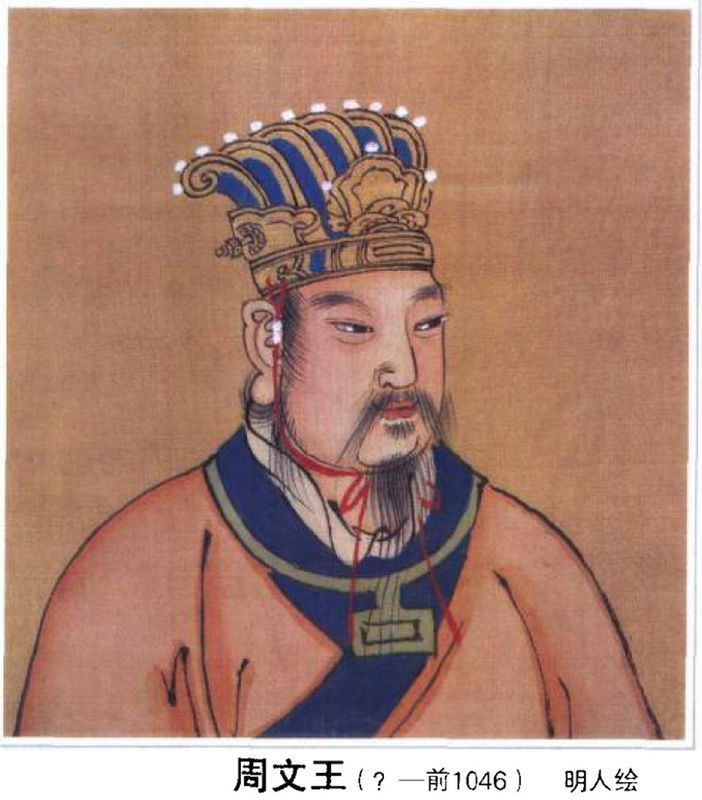
King Wen of Zhou, Ming dynasty portrait — public domain, Wikimedia Commons
c. 1050 BC — The darkest hour
The most enduring legend of the I Ching begins in a prison cell. King Wen of Zhou — a wise and beloved regional ruler — had been falsely imprisoned by the tyrannical last king of the Shang dynasty at a place called Youli (羑里). Facing uncertainty, isolation, and the real possibility of death, he did not despair. He turned his mind to the patterns of the universe.
According to tradition, King Wen took the eight trigrams — which had been passed down from the mythical sage Fuxi — and stacked them in pairs to create all 64 hexagrams. Each hexagram represented a different life situation, a different quality of time. He then wrote the hexagram judgments (卦辞, guà cí) — brief, poetic statements that captured the essential meaning of each pattern.
The story resonates because it suggests that wisdom is not born in comfort. It is in times of confinement and pressure that we are most able to see the underlying structure of change. King Wen could not change his external circumstances, so he mapped the inner landscape of possibility — and gave the world a system that has endured for three thousand years.
Legendary origins — c. 2800 BC
Before King Wen, before the Zhou dynasty, before written history itself, there was Fuxi (伏羲) — the first of the Three Sovereigns, a legendary culture hero who is said to have taught humanity hunting, fishing, writing, and the art of observing nature.
The Great Commentary (系辞传), one of the Ten Wings of the I Ching, describes how Fuxi created the eight trigrams:
"He looked up to observe the patterns in the heavens, and looked down to examine the patterns on the earth. He observed the markings of birds and beasts and the adaptations to the terrain. From near he drew from his own body; from far he drew from other things. Thus he created the eight trigrams, in order to become thoroughly conversant with the numinous and bright and to classify the myriad things."
In this telling, the I Ching is not revealed by a god or a supernatural being. It is observed — drawn from the actual patterns of the natural world: the cycle of day and night, the phases of the moon, the seasons, the growth and decay of all living things. It is an empirical system grounded in thousands of years of careful attention.

I Ching, Song dynasty print (c. 1100) — public domain, Wikimedia Commons
c. 1000–750 BC
Western Zhou — The core divination text (Zhou Yi) is compiled, using yarrow stalks to generate hexagram readings.
c. 500–200 BC
Warring States — Philosophical commentaries (the 'Ten Wings') are added, transforming it into a cosmological and moral text.
136 BC
Han Dynasty — Emperor Wu declares the I Ching 'first among the classics.' It becomes part of the Five Classics of Confucianism.
c. 1100 AD
Song Dynasty — Neo-Confucian scholar Zhu Xi reconstructs the yarrow-stalk method still used today. Printed editions spread widely.
1703 AD
Leibniz discovers the I Ching binary structure and sees it as evidence of a universal logic — an early link to computer science.
1920s–50s
Carl Jung explores the I Ching as a tool for synchronicity and psychological reflection, introducing it to Western psychotherapy.
Today
Used worldwide for self-reflection, meditation, creative inspiration, and decision guidance.
At the heart of the I Ching is a single, elegant idea: all of reality emerges from the interplay of two fundamental forces. Yang (⚊) — the unbroken line — represents the active, creative, light, and initiating principle. Yin (⚋) — the broken line — represents the receptive, dark, yielding, and completing principle.
Neither is "good" or "bad." A healthy life is one that moves with the rhythm between them — knowing when to act and when to wait, when to speak and when to listen, when to push forward and when to restore.
When you consult the I Ching, you are essentially asking: Where am I in this dance right now?
The Taijitu (太极图) — the symbol of yin and yang in perfect balance.
Stacking three yin-or-yang lines gives eight fundamental archetypes called trigrams (八卦, bāguà). Each represents a natural force and a quality of energy:
Heaven — Creative, strong, initiating
Earth — Receptive, nurturing, supporting
Thunder — Awakening, stirring action
Water — Deep, flowing, the abysmal
Mountain — Stillness, resting, observing
Wind — Gentle, penetrating, subtle
Fire — Clinging, illuminating, clarity
Lake — Joyous, open, receptive
When two trigrams are combined — one above, one below — they form a hexagram (卦, guà). There are 8 × 8 = 64 possible hexagrams, and these 64 patterns are the complete vocabulary of the I Ching.
Each hexagram describes a type of moment. For example, Hexagram 1 The Creative (乾, Qián) describes a time of pure initiating energy — like spring itself. Hexagram 2 The Receptive (坤, Kūn) describes the power of yielding and supporting from below.
The hexagrams are usually read in the King Wen sequence, an order dating back to the early Zhou dynasty that pairs each hexagram with its complement — an upside-down or yin-inverted version of itself. This pairing suggests that every situation contains the seed of its opposite, and change is the only constant.
In traditional practice, a diviner would cast 50 dried yarrow stalks or toss three coins six times to build up a hexagram line by line. The resulting hexagram is then interpreted using the ancient texts. Our platform uses the same 64 hexagrams as a structured system for self-reflection.
Return (复, Fù)
A quiet signal of renewal, rhythm, and the next honest step. The old cycle is complete; a new one begins. This hexagram appears on the winter solstice — the darkest day, after which light slowly returns.
Keywords: balance, timing, renewal. This is not a time for grand declarations, but for noticing what is ready to emerge naturally.
Gottfried Wilhelm Leibniz
Mathematician, 1703
Leibniz, co-inventor of calculus, saw the binary structure of the I Ching hexagrams (broken line = 0, unbroken line = 1) and recognized it as a universal symbolic language. His correspondence with Jesuit missionaries in China led to one of the earliest intellectual bridges between Eastern and Western thought.
Carl Gustav Jung
Psychologist, 1920s–1950s
Jung wrote extensively about the I Ching as a tool for exploring synchronicity — meaningful coincidences that are not causally connected yet carry psychological significance. He saw the hexagrams as archetypes of the collective unconscious, similar to the motifs found in dreams and myths across all cultures.
Terence McKenna
Ethnobotanist, 1970s–1990s
McKenna developed his "Timewave Zero" theory based on the King Wen sequence of the I Ching, arguing that the hexagram order encoded a fractal pattern of novelty and habit in time. While speculative, his work illustrates the enduring fascination the I Ching holds for those seeking deeper patterns in experience.
This platform does not use AI, predictive algorithms, or psychics. Every reading is drawn from the same structured knowledge base of 64 hexagrams that has been studied for centuries. When you ask a question, the system selects a hexagram — at random, or seeded by the date for the daily insight — and presents its traditional wisdom in modern, reflective language.
The goal is not to tell you what to do. The goal is to help you pause, name the quality of the present moment, and choose your next step from a place of awareness rather than reaction. This is the original purpose of the I Ching: not prediction, but clarity.
A note: This platform provides reflective and spiritual guidance for personal growth and entertainment purposes only. It does not offer medical, legal, financial, or mental-health advice. The I Ching is a tool for contemplation, not a substitute for professional counsel.